Tell us about the job
Takes about a minute. No obligation.
A contractor sizing central AC here starts from a question most installs elsewhere skip: whether the equipment will ever run at all. Homes in Anchorage Municipality, AK have essentially no cooling season — no month of the year is warm enough to call for it. A compressor that never cycles does not escape wear; it corrodes at fittings, seizes from disuse, and loses refrigerant through seals that never warm up and flex. The first call of a rare hot spell is when that failure surfaces. A proper install accounts for long idle periods, which means specifying components and refrigerant charge with dormancy in mind rather than peak summer load.
Ductwork laid in for one generation of equipment and then pressed into service for another is a common situation in Anchorage Municipality's housing stock. Half the homes in Anchorage Municipality, Alaska were built in 1982 or earlier (2020-2024 ACS 5-year). A contractor quoting a central AC installation here has to assess whether the existing duct runs, their dimensions, and their routing can carry the airflow a modern cooling system requires. If they cannot, the duct work becomes part of the job scope before the unit is ever selected. The electrical service gets the same look, since a system sized for today's cooling loads draws differently than what the panel was originally configured around.
What Gets Installed With a New Central AC
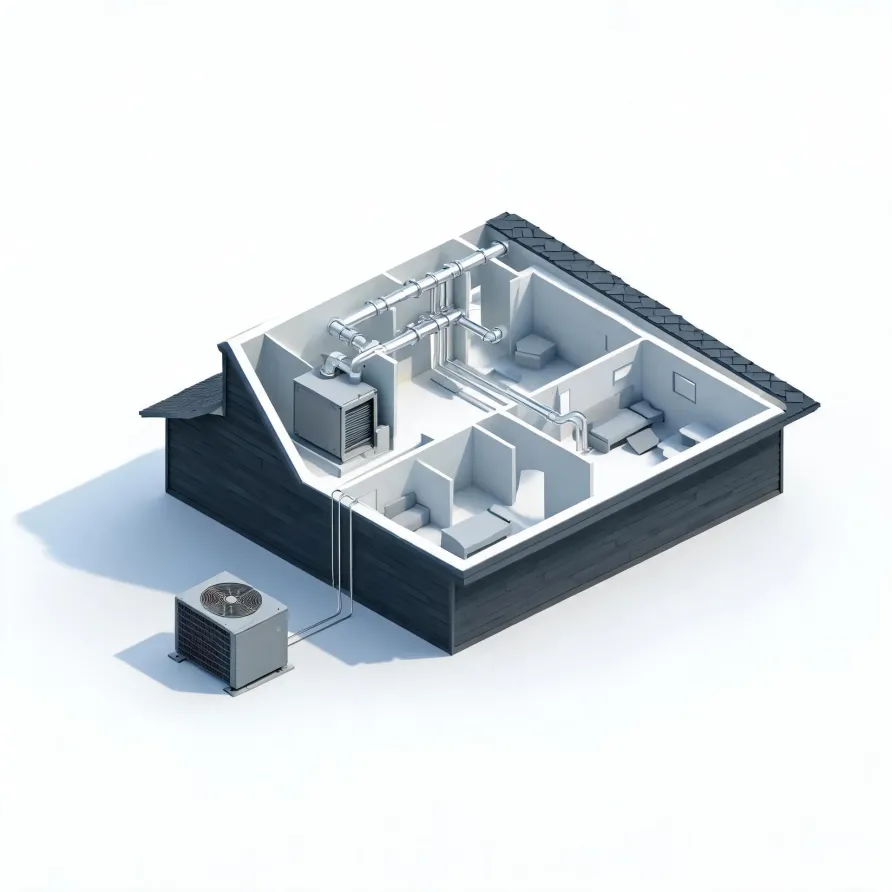
The outdoor unit sits on a concrete pad beside the house and holds the compressor and condenser coil, the two components that shed heat from the refrigerant. Inside, the air handler or furnace-mounted evaporator coil lives in a utility space, basement, or closet and is the piece the refrigerant runs through to pull heat from indoor air.
A refrigerant line set runs between those two units, connecting the outdoor pad to the indoor cabinet through the wall or floor. The thermostat mounts on an interior wall where it reads the air temperature and tells the system when to run.
The drawing shows a representative layout, and a licensed contractor determines exactly what applies to this house.
Find a contractor in Anchorage MunicipalityAnchorage Municipality by the Numbers
Half the homes in Anchorage Municipality, Alaska were built in 1982 or earlier (2020-2024 ACS 5-year).
U.S. Census Bureau, 2020-2024 American Community Survey 5-Year EstimatesAnchorage Municipality, Alaska holds 120,348 housing units (2020-2024 ACS 5-year).
U.S. Census Bureau, 2020-2024 American Community Survey 5-Year EstimatesOwners occupy 63.9% of the occupied homes in Anchorage Municipality, Alaska (2020-2024 ACS 5-year).
U.S. Census Bureau, 2020-2024 American Community Survey 5-Year EstimatesCodes & Standards Behind Central AC Installation in Anchorage Municipality, Alaska9 sourced rules and standards
What the Installation Actually Looks Like
Split-system central air conditioners rated below 45,000 Btu/h manufactured on or after January 1, 2023 must meet a federal minimum of 13.4 SEER2.
Split-system central air conditioners rated at or above 45,000 Btu/h manufactured on or after January 1, 2023 must meet a federal minimum of 13.4 SEER2.
Split-system central air conditioners manufactured between January 1, 2015 and December 31, 2022 had to meet 13 SEER, the metric that preceded SEER2.
Single-package central air conditioners manufactured on or after January 1, 2023 must meet a federal minimum of 13.4 SEER2.
Space-constrained central air conditioners manufactured on or after January 1, 2023 must meet a federal minimum of 11.7 SEER2.
Federal efficiency standards for split-system central air conditioners and heat pumps are set on each certified combination of outdoor unit and indoor coil rather than on the outdoor unit alone.
Residential and light commercial air conditioning and heat pump systems assembled in the field, including mini-splits and unitary systems, may not be installed on or after January 1, 2025 using a refrigerant with a global warming potential above 700.
A field-assembled system whose specified components were all manufactured or imported before January 1, 2025 carries no installation compliance date under the refrigerant restrictions and may still be installed.
Licensing and Legal Requirements in Anchorage Municipality, Alaska
Alaska requires a certificate of registration as a contractor: a person may not submit a bid or work as a contractor until the department has issued one.