Tell us about the job
Takes about a minute. No obligation.
Central AC in Sitka is installed, maintained, and occasionally repaired, yet the compressor in most homes has never been seriously worked. Homes in Sitka City and Borough, AK have essentially no cooling season — no month of the year is warm enough to call for it. A compressor that sits idle indefinitely still ages: seals dry, refrigerant migrates, and electrical contacts corrode from disuse. When a homeowner calls for a repair, the contractor is dealing with a system that deteriorated on the shelf, not one that wore out under load. That changes what they look at first, toward electrical components and seals rather than anything that cycles hard under heat stress.
Aging ductwork and electrical service are an installation question. For repair work, the housing stock raises a different problem. Half the homes in Sitka City and Borough, Alaska were built in 1980 or earlier (2020-2024 ACS 5-year). A system running in a house that old has often outlasted the parts catalog it was built around, and what a contractor finds once the unit is open determines whether the repair is a same-week fix or a search for components that current distributors stopped stocking years ago. That gap between what is on the shelf and what the system actually takes is where repair jobs in Sitka tend to slow down or change scope.
The Parts of a Central AC a Contractor Checks During a Repair
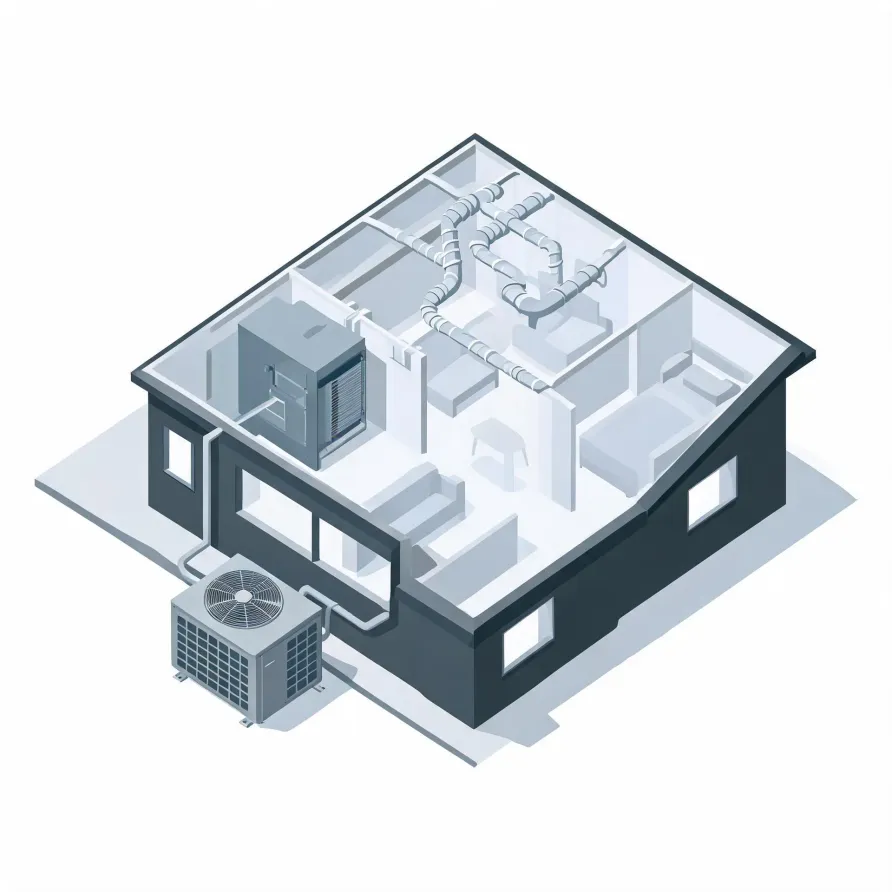
The outdoor condenser unit sits outside the house, usually against a wall or on a pad, and it holds the compressor and the condenser coil. These are where most repairs start. A failing compressor often shows up as a system that runs but never cools, and a damaged or dirty condenser coil puts the same strain on the whole system.
Inside the house, the air handler contains the evaporator coil and the blower motor. The evaporator coil pulls heat out of indoor air, so a frozen or leaking coil is a direct cause of poor cooling. The blower moves air across that coil and through the house, and a weak or failed motor means air stops moving regardless of how well the rest of the system is working. The expansion valve and the refrigerant lines connect the two units, and low refrigerant or a stuck valve are common targets when a contractor narrows down where the problem sits.
The drawing shows a typical central AC layout, and a licensed contractor determines which components apply to the specific system and conditions in your home.
Find a contractor in Sitka City and BoroughSitka City and Borough by the Facts
7 severe weather events were recorded in Sitka City and Borough, Alaska between 2015 and 2024.
NOAA National Centers for Environmental Information, Storm Events Database, bulk CSV export, events 2015-01-01 through 2024-12-31.Half the homes in Sitka City and Borough, Alaska were built in 1980 or earlier (2020-2024 ACS 5-year).
U.S. Census Bureau, 2020-2024 American Community Survey 5-Year EstimatesSitka City and Borough, Alaska holds 4,161 housing units (2020-2024 ACS 5-year).
U.S. Census Bureau, 2020-2024 American Community Survey 5-Year EstimatesOwners occupy 61.7% of the occupied homes in Sitka City and Borough, Alaska (2020-2024 ACS 5-year).
U.S. Census Bureau, 2020-2024 American Community Survey 5-Year EstimatesCodes & Standards Governing Central AC Repair in Sitka City and Borough, Alaska9 sourced rules and standards
What HVAC Repair Looks Like in Sitka
Split-system central air conditioners rated below 45,000 Btu/h manufactured on or after January 1, 2023 must meet a federal minimum of 13.4 SEER2.
Split-system central air conditioners rated at or above 45,000 Btu/h manufactured on or after January 1, 2023 must meet a federal minimum of 13.4 SEER2.
Split-system central air conditioners manufactured between January 1, 2015 and December 31, 2022 had to meet 13 SEER, the metric that preceded SEER2.
Single-package central air conditioners manufactured on or after January 1, 2023 must meet a federal minimum of 13.4 SEER2.
Space-constrained central air conditioners manufactured on or after January 1, 2023 must meet a federal minimum of 11.7 SEER2.
Federal efficiency standards for split-system central air conditioners and heat pumps are set on each certified combination of outdoor unit and indoor coil rather than on the outdoor unit alone.
Residential and light commercial air conditioning and heat pump systems assembled in the field, including mini-splits and unitary systems, may not be installed on or after January 1, 2025 using a refrigerant with a global warming potential above 700.
A field-assembled system whose specified components were all manufactured or imported before January 1, 2025 carries no installation compliance date under the refrigerant restrictions and may still be installed.
Licensing Rules for HVAC Repair in Sitka City and Borough, Alaska
Alaska requires a certificate of registration as a contractor: a person may not submit a bid or work as a contractor until the department has issued one.