Tell us about the job
Takes about a minute. No obligation.
A contractor quoting AC repair here has to rule out cycling wear before pricing anything else, and ruling it out is quick. Homes in Lake and Peninsula Borough, AK have essentially no cooling season — no month of the year is warm enough to call for it. Compressors fail by accumulating starts, stops, and heat stress through long cooling seasons, and a compressor here has had none of that to accumulate. When a contactor burns out or refrigerant migrates, the cause is almost always age or a standing-idle failure mode, such as oil pooling in the compressor during an extended off period. The contractor's first question is how long the unit sat untouched, not how hard it was running.
Ductwork in much of this borough's housing has been worked on across several rounds of equipment before whatever is running now. Half the homes in Lake and Peninsula Borough, Alaska were built in 1986 or earlier (2020-2024 ACS 5-year). A contractor who opens a central AC unit here often finds evidence of earlier repairs layered on top of each other, each one a response to a different failure in a different system. That history shows up in how components have worn, which seals have been replaced and which have not, and whether the refrigerant circuit reflects the original design or something improvised along the way. The parts a system in that condition actually needs are not predictable from the outside.
The Parts of a Central AC a Contractor Checks First
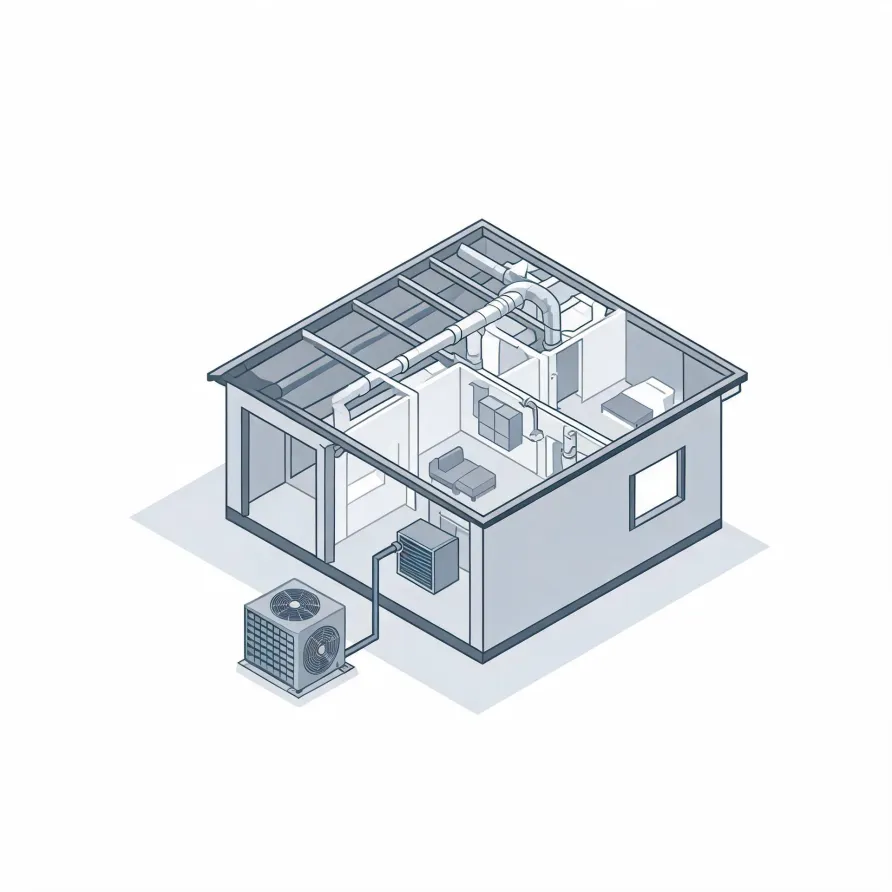
The outdoor condenser unit sits outside the house, usually on a concrete pad beside the foundation, and it carries the compressor and the condenser coil. These are the pieces a contractor goes to first when a system stops cooling, because a failed compressor or a fouled coil will shut down the whole system. The air handler or furnace cabinet sits indoors, most often in a utility closet, basement, or attic, and it holds the evaporator coil and the blower that moves air through the house.
The refrigerant lines run between the two cabinets, and a leak anywhere along them will cause the system to lose its ability to move heat. The thermostat on the wall is the other piece a contractor checks early, because a wiring fault or a failed sensor there can mimic a much larger problem. The condensate drain line runs out from the indoor cabinet and a blockage in it can trip a safety switch and shut the system down.
The drawing shows the general layout of a central AC system, and a licensed contractor determines which components apply and what condition they are in for your specific home.
Find a contractor in Lake and Peninsula BoroughLake and Peninsula Borough, by the numbers
Half the homes in Lake and Peninsula Borough, Alaska were built in 1986 or earlier (2020-2024 ACS 5-year).
U.S. Census Bureau, 2020-2024 American Community Survey 5-Year EstimatesLake and Peninsula Borough, Alaska holds 1,336 housing units (2020-2024 ACS 5-year).
U.S. Census Bureau, 2020-2024 American Community Survey 5-Year EstimatesOwners occupy 65.4% of the occupied homes in Lake and Peninsula Borough, Alaska (2020-2024 ACS 5-year).
U.S. Census Bureau, 2020-2024 American Community Survey 5-Year EstimatesRules & Standards Governing Central AC Repair in Lake and Peninsula Borough, Alaska9 sourced rules and standards
What HVAC Repair Looks Like in Lake and Peninsula Borough
Split-system central air conditioners rated below 45,000 Btu/h manufactured on or after January 1, 2023 must meet a federal minimum of 13.4 SEER2.
Split-system central air conditioners rated at or above 45,000 Btu/h manufactured on or after January 1, 2023 must meet a federal minimum of 13.4 SEER2.
Split-system central air conditioners manufactured between January 1, 2015 and December 31, 2022 had to meet 13 SEER, the metric that preceded SEER2.
Single-package central air conditioners manufactured on or after January 1, 2023 must meet a federal minimum of 13.4 SEER2.
Space-constrained central air conditioners manufactured on or after January 1, 2023 must meet a federal minimum of 11.7 SEER2.
Federal efficiency standards for split-system central air conditioners and heat pumps are set on each certified combination of outdoor unit and indoor coil rather than on the outdoor unit alone.
Residential and light commercial air conditioning and heat pump systems assembled in the field, including mini-splits and unitary systems, may not be installed on or after January 1, 2025 using a refrigerant with a global warming potential above 700.
A field-assembled system whose specified components were all manufactured or imported before January 1, 2025 carries no installation compliance date under the refrigerant restrictions and may still be installed.
Licensing Rules for HVAC Repair in Lake and Peninsula Borough, Alaska
Alaska requires a certificate of registration as a contractor: a person may not submit a bid or work as a contractor until the department has issued one.